The United Nations Conference on Trade and Development (UNCTAD) published its World Investment Report 2026, highlighting Chile’s consolidation as one of the region’s most attractive destinations for foreign direct investment (FDI) in a year marked by an uneven recovery in global capital flows.
According to the report, global FDI showed resilience in 2025, though recovery remains fragile.
Global foreign direct investment flows increased by 6%, reaching US$1.6 trillion. Capital inflows grew by 11% in developed economies and by 2% in developing economies.
Excluding flows transiting through major European financial centers, global FDI rose 4%, following two consecutive years of decline.
The report warns that the outlook for 2026 is subject to significant downside risks, including uncertainty around trade policy, geopolitical tensions and ongoing conflicts.
In terms of sectoral composition, investment activity is increasingly concentrated in a small number of capital- and technology-intensive sectors.
Growth in the value of FDI projects was driven primarily by investment in data centers, followed by the oil and gas sector and semiconductors.
In contrast, most other sectors recorded significant declines, including renewable energy, infrastructure (excluding data centers) and manufacturing.
The report also highlights a significant increase in flows to less developed countries (+21%). However, investment in structurally weak and vulnerable economies remains highly concentrated in a small number of countries, most of which are rich in natural resources.
Likewise, investment linked to the Sustainable Development Goals (SDGs) rebounded in 2025, albeit unevenly: both the value and the number of projects announced in developing economies increased, particularly in less developed countries, but this rebound remained concentrated in a few sectors and economies, highlighting persistent challenges in mobilizing investment toward smaller-scale projects and economies.
Finally, the report notes that the global investor landscape has become more diverse, with new actors joining traditional investors.
In this global context, the report highlights Chile as a major destination for FDI in the region, particularly in the energy and mining sectors. Foreign direct investment inflows rose from US$11.8 billion to US$13.1 billion in 2025.
Lithium—within the so-called “lithium triangle” formed by Argentina, Bolivia and Chile—and copper—produced mainly by Chile and Peru—remained the main drivers of these flows, even amid fluctuating announcements of new greenfield projects.
The report also highlights regulatory advances in Chile, including a seven-point strategy that prioritizes investment promotion and facilitation and identifies 10 legislative initiatives for priority treatment.
Among these, the Framework Law on Sectoral Authorizations stands out; it seeks to improve legal certainty, transparency and administrative efficiency in the processing of sectoral permits through standardized procedures, maximum decision-making timeframes, parallel processing, and the use of a single digital platform.
The document also highlights the role of trade and investment agreements signed by Chile regarding critical raw materials and minerals. Of particular note is the Advanced Framework Agreement between Chile and the European Union (2023), which includes chapters on energy and raw materials. Once it enters into force, the advanced framework will replace existing bilateral investment treaties with next-generation investment protection provisions.
According to the report, Chile remains one of the world’s leading producers of copper and lithium and has developed a robust ecosystem of mining suppliers. Higher-value-added industrial activities, such as battery manufacturing, are still in the development stage, with public policy efforts focused on strengthening the country’s technological capabilities.
The report highlights the royalty reform and the tax incentive for research and development (R&D), which support technological innovation, including in the mining sector. Through challenge-based calls for proposals launched by Chile’s economic development agency (CORFO) and piloting infrastructure such as the National Piloting Center, Chile seeks to strengthen the sustainability of mining activities—for example, in lithium extraction and waste recovery—and to consolidate links between mining companies and suppliers.
The report concludes that reforms aimed at facilitating investment, together with environmental, social, and governance (ESG) standards—including goals for efficient water use and the integration of renewable energy—reinforce Chile’s reputation as a stable and sustainability-oriented country.
At InvestChile, we work every day to ensure these results continue to grow. We support foreign investors at every stage of their projects in Chile, facilitate their connection with the local business ecosystem and provide specialized information and advice to navigate a constantly evolving regulatory framework.
Our commitment is to attract high-quality investment that generates value chains, technology transfer and sustainable development across the country’s different regions.
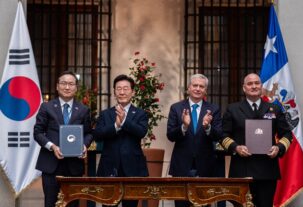
Chile and South Korea sign five cooperation agreements