National and international authorities attended the “Offshore Wind Development in Chile: An Opportunity for Just Transition and Economic Growth” seminar, which was co-organized by InvestChile, the Energy Ministry, and the Royal Danish and Royal Norwegian Embassies in Chile.
The event gathered key players from the public, private and academic sectors to discuss the progress and opportunities for offshore wind as a catalyst for sustainable growth.
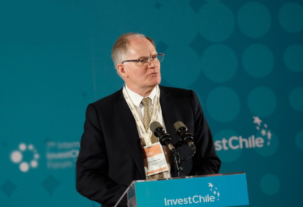
At the start of the seminar, InvestChile’s Head of Investment Promotion, Salvatore Di Giovanni, emphasized the importance of foreign direct investment (FDI) in the country’s energy transformation and the potential of offshore wind to attract new projects.
«Offshore wind energy is a solid opportunity to attract international investment and promote sustainable regional development,» he said.
Di Giovanni also underscored the collaboration between InvestChile, the Biobío Regional Government and Corporación Desarrolla Biobío to identify investment opportunities in the region.
Chilean Energy Undersecretary Luis Felipe Ramos, Norwegian Ambassador Per Anders Nilsen, Danish Ambassador Henrik Bramsen Hahn and the Biobío Regional Governor Sergio Giacaman delivered opening remarks.
Keynote speakers included Amisha Patel (Global Offshore Wind Alliance, GOWA), Eduardo Acuña (Chilean Energy Minister), Amanda L. Mera (The Carbon Trust), Mikaela Vasstrøm (University of Agder, Norway) and Ana Lía Rojas (ACERA AG).
The industry session featured the expertise of Michael Hannibal, CCO of Stiesdal, a partner at Copenhagen Infrastructure Partners (CIP) and chairman of the Global Wind Energy Council (GWEC), who shared lessons from 25 years of industry development.
During a fireside chat, Michael Hannibal discussed the potential of floating offshore wind in Chile with InvestChile’s Energy Sector Lead, Mauricio Riveros, and Energy Ministry representative, Mariel Robles, focusing on the key factors for building a competitive industry based on international experience.
The agenda continued in Santiago and Concepción with a delegation of Nordic experts.
In the capital, Amisha Patel (GOWA) held technical meetings with public sector representatives, including the Energy, Economy, Environment and Transport ministries as well as institutions like the Environmental Assessment Service, the National Electricity Coordinator, Chilean State Development Corporation (CORFO), DIRECTEMAR, the Chilean Navy and InvestChile.
Mauricio Riveros, Camila Vivanco and Javiera Ábalos represented InvestChile, discussing the opportunities offshore wind offers to boost industrial development and attract investment at the regional level.
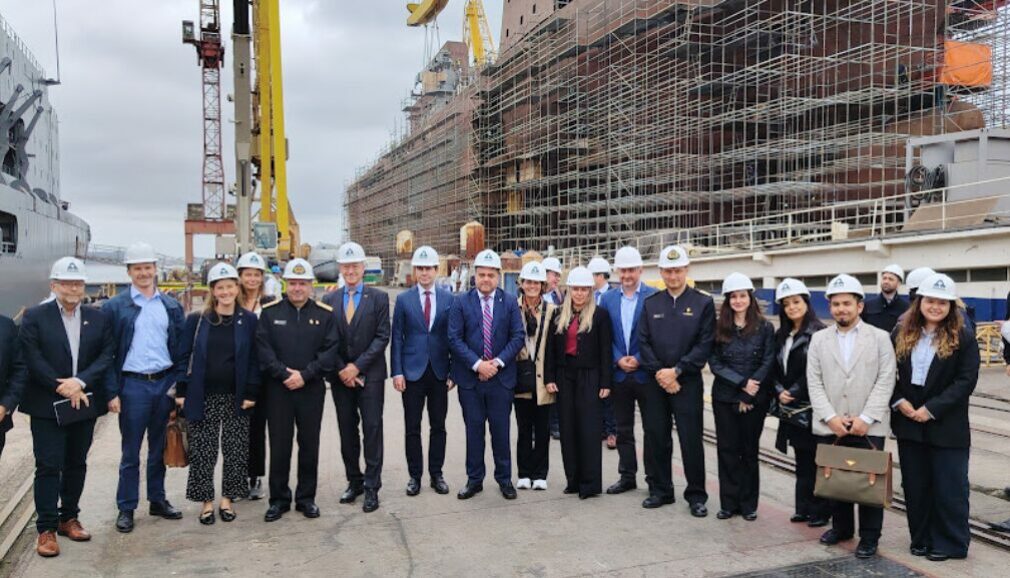
As part of the “Offshore Wind Development in Chile: An Opportunity for a Just Transition and Economic Growth” program, the international delegation visited the Biobío Region to explore its industrial and port potential.
To kick off the activities, Regional Governor Sergio Giacaman welcomed Ambassadors Henrik Bramsen Hahn (Denmark) and Per Anders Nilsen (Norway).
The agenda included visits to ASMAR and the Port of San Vicente (SVTI S.A.), where General Manager Cristian Wulf discussed expansion plans and logistical capabilities to support future offshore projects.
The delegation met with Macarena Vera and Danny Baesler from Corporación Desarrolla Biobío to explore new areas of cooperation.
The day concluded at the Universidad del Desarrollo in Concepción with technical roundtables featuring representatives from the public, private and academic realms. Michael Hannibal (Stiesdal / CIP / GWEC), Úna Brosnan (GOWA), Sille Grjotheim (DNV), Oskar Ernst (Green Power Denmark) and Mikaela Vasstrøm (University of Agder) participated.
Mauricio Riveros shared InvestChile’s vision for offshore wind as a catalyst for industrial and energy development. He also moderated a panel of international experts. Camila Vivanco led the roundtable featuring representatives from the public sector and academia.
Gabriela Jorquera and María Elena Cobo from InvestChile also took part.
The discussions reaffirmed Biobío’s solid industrial, academic and port infrastructure—ideal conditions for developing a sustainable offshore wind industry that can boost regional growth and create jobs.